

• Flip Book • eNews • eAdventures • eCities • eCargoIntl • eBikeTypes • eRoad • eGravel • eMTB • eUrban • eCargo • eBikeTests • eAccessories • eBikeShops • eFeatures •

• Flip Book • eNews • eAdventures • eCities • eCargoIntl • eBikeTypes • eRoad • eGravel • eMTB • eUrban • eCargo • eBikeTests • eAccessories • eBikeShops • eFeatures •
May 2, 2026 - As electric bicycles hold the potential to revolutionize how Canadians move, the role of national cycling advocacy has never been more vital. Vélo Canada Bikes, the country’s leading voice for everyday cycling, has evolved over the past decade from a grassroots coalition into a sophisticated federal advocacy organization.

Building a Unified Voice
The history of bike advocacy in Canada is as long as the bicycle itself, stretching back to the 19th-century “wheelmen” associations that first lobbied for paved roads across the Dominion. Pioneers like Gabriel Lupien, who founded Vélo Québec in 1967, and activists such as Claire Morissette and Bob Silverman in Montréal, fought the “battles of the ’70s” to secure the first urban lanes. Over the decades, organizations like Cycle Toronto, the British Columbia Cycling Coalition, and HUB Cycling emerged as formidable regional champions, alongside countless others from coast to coast to coast.
However, despite these deep roots, there was no federal government legislation on cycling as a matter of national transportation, climate and health policy. Discussions began between bike activists across the country to address this gap in 2009.

After years of coordination and planning, a fateful meeting was held on the sidelines of the Vancouver Velo-City Global in June 2012.
The gathering convened local leaders to launch a national federation: Canada Bikes. Participants included then–Member of Parliament Olivia Chow, urbanist Gil Penalosa, founding board members Arne Elias, Arno Schortinghuis and Richard Campbell. Their mission was clear: to ensure that the federal government treated cycling not as a niche hobby, but as a vital pillar of the Canadian transportation network.
Mobilizing for a National Cycling Strategy
In seeking to reshape the Canadian cycling landscape, Canada Bikes looked to international precedents where national coordination had already proven effective. Countries like the Netherlands had pioneered national cycling master plans as early as 1990, while Germany (2002) and Ireland (2009) demonstrated that federal oversight—coupled with dedicated funding — was the essential missing gear required to scale local successes into safe, connected national cycling networks.
Inspired by these global models, Canada Bikes formalized its focus on convincing the federal government to play a larger role in cycling by establishing two key policy goals: a national cycling strategy and a dedicated infrastructure fund.

To advance its policy goals, Canada Bikes convened a series of National Bike Summits (2017–2019) in Ottawa. With the support of industry players like MEC, Bosch, SRAM, OGC, Shimano, Trek, Salsa, Giant, Urban Racks and Lectric eBikes, these summits grew steadily in both stature and attendance.
They brought together parliamentarians, advocates, industry leaders and researchers to demonstrate the economic, environmental and health benefits of bicycle- friendly communities.
These events were often accompanied by “lobby days,” where advocates met directly with elected officials to make the case for federal support.
In 2018, the organization rebranded to Vélo Canada coalition of national partners including Active School Travel Canada, CAA, Green Communities Canada, Heart & Stroke, Piétons Québec and Trans Canada Trail.

Policy Breakthroughs and the Pandemic Pivot
The arrival of the COVID-19 pandemic in 2020 triggered the unprecedented “bike boom,” with demand for bicycles surging by 200–300% and a pause on in-person gatherings. But the organization quickly got to work, recognizing cycling’s role in a crisis. Vélo Canada Bikes successfully advocated for bike mechanics to be recognized as an essential service. This ensured that while much of the retail sector closed, bike shops remained open to service the thousands of Canadians relying on two wheels for essential travel.
Years of effort led to a historic policy breakthrough under the then Minister of Infrastructure and Communities — and committed cyclist — Catherine McKenna. In March 2021, Minister McKenna announced the first-ever Active Transportation Fund, a $400 million investment dedicated
to human-powered mobility. Kate Walker, then Vice-Chair of Vélo Canada Bikes, was alongside the Minister for this historic unveiling. This was followed in July 2021 by the official launch of Canada’s first National Active Transportation Strategy. Vélo Canada Bikes Chair at the time, Anders Swanson, joined Minister McKenna in downtown Toronto for this second announcement, marking the culmination of a decade of advocacy. The Fund proved so popular that it received over $3 billion in applications, proving that municipalities were ready to build safe, connected cycling and walking networks.

Bike Day on the Hill
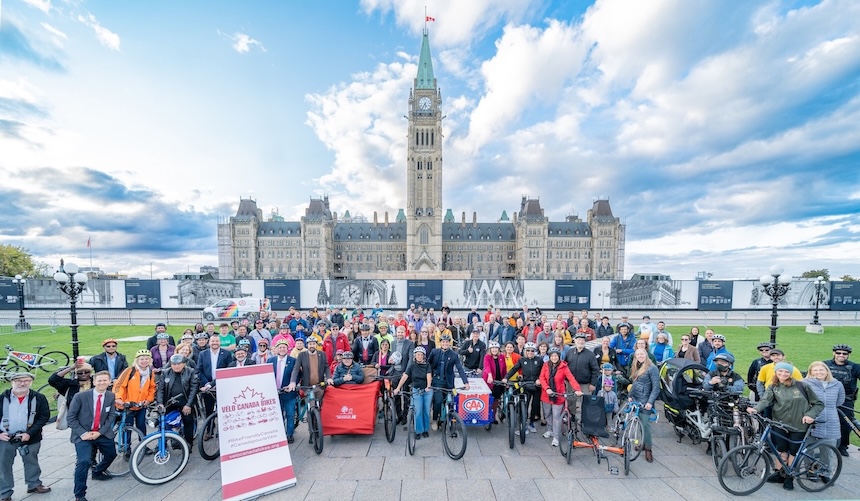
From 2012 until present, one of Vélo Canada Bikes’ most visible and recurring awareness-raising efforts has been Bike Day on the Hill. Originally established by Conservative Member of Parliament John Weston, and amplified by successive Senators such as Nancy Greene Raine and Marty Deacon, the event has grown into a major non-partisan fixture on the parliamentary calendar. For the 10th edition in late 2025, the event attracted 22 parliamentarians — including four ministers — to celebrate “Cycling for Canadian Prosperity” and compete in the now-famous Parliamentary Slow Bike Challenge.
Data, Research, and the “All Ages and Abilities” Gold Standard
Beyond direct lobbying, Vélo Canada Bikes has become a hub for research mobilization. Recognizing that “what gets counted, counts,” the organization partnered with academics to develop Canada’s first-ever national bicycle count, Pedal Poll/ Sondo Vélo, in 2021. By 2025, hundreds of volunteers across 31 communities were counting nearly 50,000 riders annually, providing the data necessary to justify cycling infrastructure investments.

Vélo Canada Bikes is currently a national partner on the CapaCITY/É research project, which aims to
accelerate the uptake of All Ages and Abilities bicycle networks. To further support local planners, the organization developed a Shorthand Cost-Benefit Analysis Tool, to help municipalities quantify the health, environmental and economic benefits of cycling infrastructure.
The Current Landscape: Defending Gains
The success of the national cycling movement has also brought new challenges. Following the depletion of the initial Active Transportation Fund, Vélo Canada Bikes successfully secured a further $500 million for active transportation infrastructure in late 2024. However, the political landscape shifted with the fall 2025 budget under Prime Minister Mark Carney. The organization is currently working with its allies to ensure that these funds are secure amidst a broader government focus on cost cutting and fiscal reform.
Simultaneously, Vélo Canada Bikes has moved into a defensive posture to protect decades
of local progress against a rising tide of “bikelash.” The organization has been a vocal opponent of regressive provincial legislation, such as Ontario’s Bill 212 and Bill 60, which seek to limit or remove existing bike lanes.

Much more work is needed to transform Canada into a bicycle-friendly nation. If you share a vision of a Canada where cycling is safe and accessible for all people and all journeys, you can take tangible actions to support the national cycling movement. You can join members like Cycling Canada, HLC, United Wheels and SMS Product Design, donate to Vélo Canada Bikes, or participate in initiatives like the Pedal Poll/Sondo Vélo national bicycle count by visiting www.velocanadabikes.org.
This article has been submitted by Samuel Benoit, Executive Director, Vélo Canada Bikes.