












August 14, 2026 - (Toronto, Ontario) Cycling advocates are facing a setback in their landmark Charter challenge case against Ontario’s anti-bike lane law after the Court of Appeal for Ontario overturned their victory at the Superior Court.
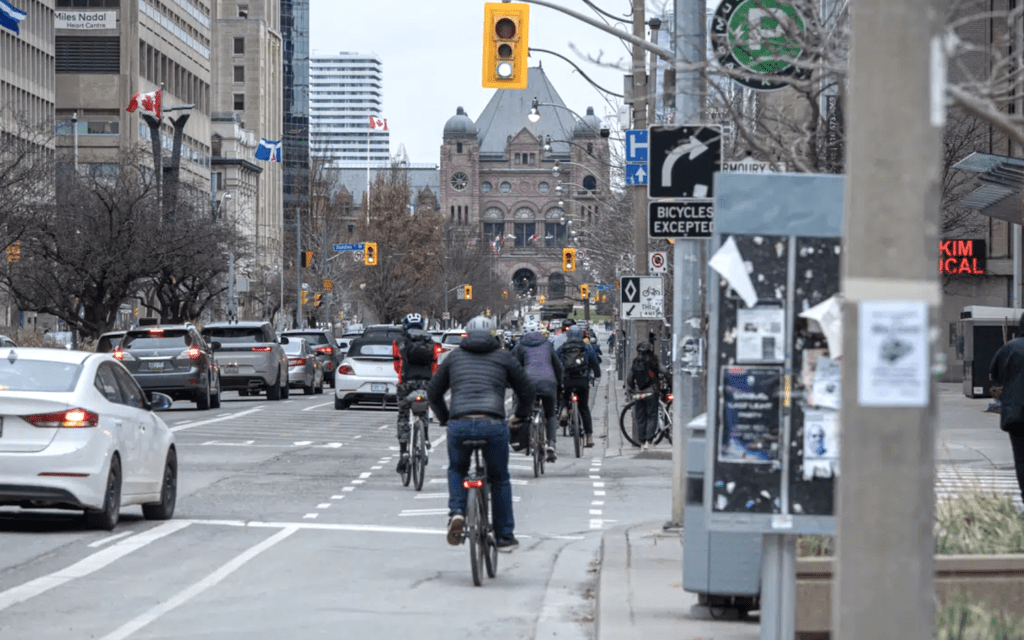
The case, brought by Cycle Toronto, Eva Stanger-Ross, and Narada Kiondo, represented by lawyers from Ecojustice and Paliare Roland Rosenberg Rothstein LLP, challenged a provision of Bill 212, Reducing Gridlock, Saving You Time Act, 2024 that would remove key protected bike lanes in Toronto as a violation of Section 7 of the Canadian Charter of Rights and Freedoms.
The facts on the ground have not changed. Removing protected bike lanes on Bloor Street, University Avenue, and Yonge Street puts people at risk, and the Ford government’s own internal documents confirm it. A government-commissioned report found that removal could increase collisions by 54 per cent for all road users and would be unlikely to reduce congestion.
In the past ten years, 28 people have been killed and 380 seriously injured while cycling in Toronto, most on streets without protected cycling infrastructure. The public health case for protected bike lanes is not a matter of legal interpretation but of evidence. The evidence remains clear that bike lanes make streets safer for all road users, including drivers and pedestrians.
Bronwyn Roe, Program Director, Healthy Communities at Ecojustice, said: “Today’s ruling changes the legal outcome, but it does not change the facts. Bike lanes save lives. Removing key parts of Toronto’s network of protected cycling infrastructure will make the roads more dangerous for cyclists, drivers, and pedestrians. We remain committed to fighting for the safety of everyone who shares Toronto’s streets and for a healthier, more equitable, and more sustainable city.”
Michael Longfield, Executive Director at Cycle Toronto, said: “Today’s decision is an unfortunate set-back for evidence-based decision making that disappointingly asserts any government’s ability to pass legislation regardless of whether it will achieve its intended goals. This ruling does nothing to dispute the facts affirmed in our previous victory (and the government’s own experts). Bike lanes do not cause traffic congestion. Ripping them out will put people’s lives at risk. This legislation isn’t sound transportation policy, it’s a costly distraction from the government’s real responsibilities and stoking a culture war. Cycle Toronto intends to keep defending our bike lanes to the full extent of the law.”
Andrew Lewis, Partner at Paliare Roland Rosenberg Rothstein LLP, said: “The decision today is unfortunate, but it does not change the fact that any removal of Toronto’s bike lanes by the Ford government will result in an increased risk of injury and death to cyclists and indeed all road users, without materially alleviating congestion. We hope the government will, regardless of the legal result, move on from this folly.”
About Cycle Toronto
Cycle Toronto is a member-supported charity that has been leading the change for a healthier, more vibrant cycling city since 2008.
About Ecojustice
Ecojustice uses the power of the law to defend nature, combat climate change, and fight for a healthy environment. Its strategic, public interest lawsuits and advocacy lead to precedent-setting court decisions and law and policy that deliver lasting solutions to Canada’s most urgent environmental problems. As Canada’s largest environmental law charity, Ecojustice operates offices in Vancouver, Calgary, Toronto, Ottawa, and Halifax.
About Paliare Roland Rosenberg Rothstein LLP
Paliare Roland Rosenberg Rothstein LLP is a litigation boutique in Toronto. The firm is widely considered to be among Canada’s finest collection of advocates, distinguished by its capacity to navigate complex matters and high-stakes cases with rigour, clarity and integrity.
Read more here.