












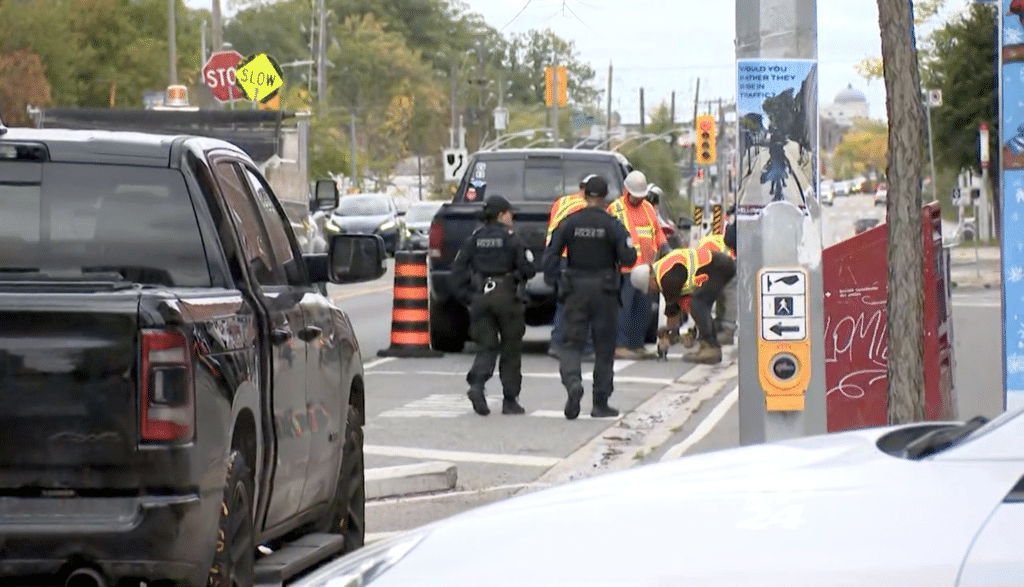
October 14, 2026 - (Toronto, ON) A large contingent of 30-40 police officers and police cars were on site at Bloor St. West in Toronto on Oct. 14 to ensure that the bike lane removal – derailed on Tuesday, Oct. 13, by a large group of protesters – went ahead as planned reports CTV and other outlets.
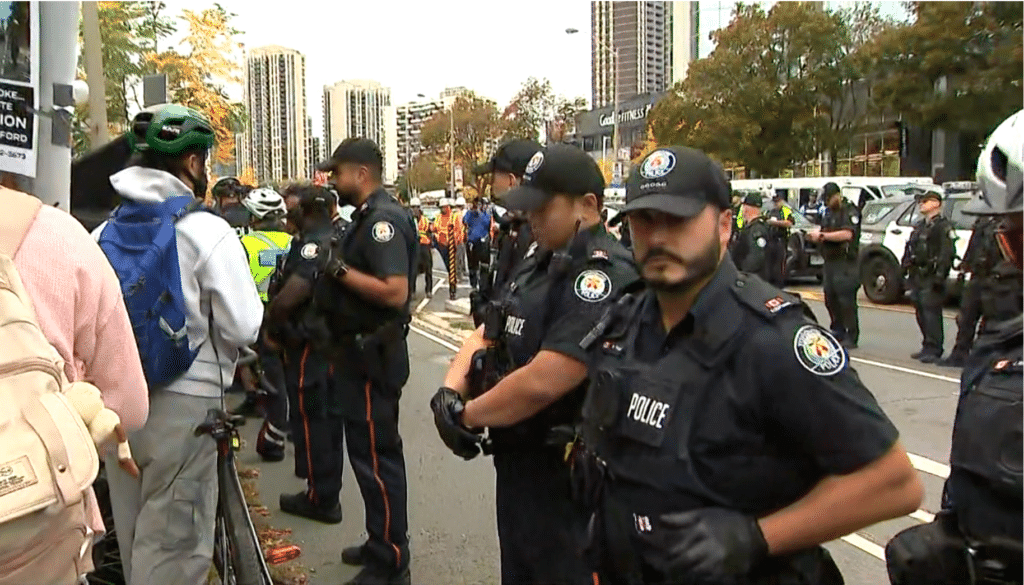
The removal was to take place in the evening, but following the late night disruption that forced pylons trucks to leave, construction crews showed up the next day with the police out in force to allow the removal work on the bike lanes to continue.
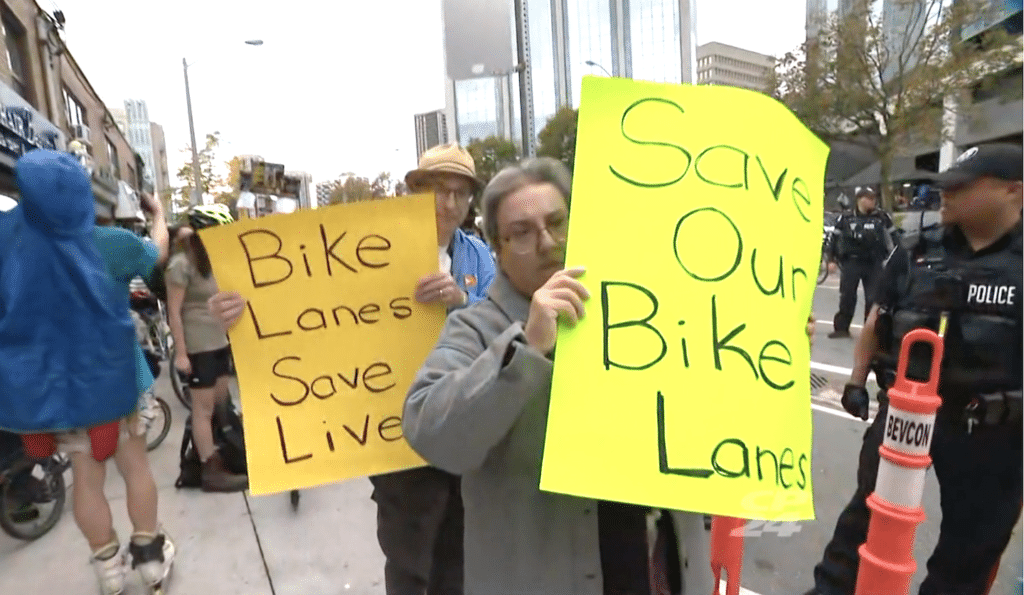
Protesters had planned to return the next evening, but the change resulted in a much smaller group of cyclists showing up to block the construction crews again. They were soon met by police who warned them to step aside or face being arrested. At least one demonstrator was led away in handcuffs by two police officers.
The province has framed the bike lane removals as a traffic relief measure, but critics say it’s an example of provincial overreach that will make streets less safe, and no less congested.
“It’s not about addressing traffic congestion and very disappointingly, it seems like rather than, you know, to try and find those win-win solutions, they’re just doubling down on spite,” said Michael Longfield, executive director of Cycle Toronto to CTV.
The battle over bike lanes has been ongoing since Premier Doug Ford’s government passed Bill 212 (the Reducing Gridlock, Saving You Time Act, 2024) in Nov. 2024 that sought to remove the bike lanes. The bill was challenged by Cycle Toronto, joined by individual applicants Eva Stanger-Ross and Narada Kiondo, and represented by lawyers from Ecojustice and Paliare Roland LLP.
The advocacy group argued that it would put people at increased risk of harm and death, thereby violating section 7 of the Charter, which protects the right to life and security of the person. In July 2025, Justice Paul Schabas agreed with Cycle Toronto’s challenge ruling that government decisions that increase risk to people, particularly vulnerable road users like cyclists, are unconstitutional when not made in accordance with the principles of fundamental justice.
The province appealed, and in mid-August, the Court of Appeal for Ontario overturned the lower court allowing Premier Doug Ford’s government to remove 19km of protected bike lanes in Toronto along Bloor St., University Ave., and Yonge St. – read more here.
The Ford government walked away from several Toronto proposals and compromises by Mayor Olivia Chow to restore traffic lanes while preserving bike lanes.
In fact, a report by the engineering firm CIMA+, commissioned by the province, estimated that removing the bike lanes could increase collisions among all road users, including cyclists, pedestrians, and drivers, by as much as 54%, and found no clear evidence that their removal would ease congestion.
A City of Toronto staff report from Nov. 2024 estimated the minimum direct cost of removing the 19km of bike lanes at $48 million, on top of the $27 million already spent installing them. Critics argue that it’s a colossal waste of taxpayer money.
Cycle Toronto is taking the fight to the Supreme Court of Canada “to provide clarity about the scope of the rights to life and security of the person protected by Section 7 of the Charter.” – read more here.
Countless groups including the Ontario healthcare workers, the Ontario Society of Professional Engineers (OSPE) and many others have denounced Ontario’s plans to remove bike lanes and urge the province to back down.
According to Longfield it’s an international embarrassment as most major cities like Paris, London, New York and many others are expanding their cycling networks and usage. Yet Ford and Transportation Minister Prabmeet Sarkaria claim to know better… more than the evidence shows by their own experts.
Read the full CTV report and video coverage here.