





December 4, 2025 - The Belgian Cycle Logistics Federation (BCLF) has published its Barometer 2025. This publication coincides with the third edition of the event Route33 (1), which will take place today, 2 December, at 9 a.m. in Anderlecht Expo. The event is attended by the Minister of Mobility, Climate and Ecological Transition, Jean-Luc Crucke, as well as numerous representatives from the sector. This Barometer highlights the spectacular growth of bicycle logistics in Belgium: a sector that positions itself as one of the pillars of the transition to more sustainable, efficient and resilient logistics.
In 2024, 76.08% (2) of Belgians made online purchases (compared to 71.76% the European average). In Brussels, motorists have lost 118 hours in traffic jams, making the city among the three most traffic-sludged cities in Europe (3). Because urban space is limited, cities need to find solutions to relieve their centres while meeting the growing demand for deliveries.
In this context, bicycle logistics profiles itself as a strategic solution: it enables fast, efficient and sustainable deliveries, while worden reducing congestion and environmental impact.
2024: a year of record growth for bicycle logistics
In 2024, the sector will continue its strong growth:
• 5.2 million parcels delivered in 2024, compared to 3 million in 2023 – an increase of +70% in one year.
• 6,200 jobs in bicycle logistics (excluding platform economics).
• 10,700,000 km travelled by bike, +30% compared to 2023.
The figures show that the sector is becoming more professional and that cargo bikes are widely used by the last mile players.
Brussels remains the region with the most bicycle deliveries in Belgium, accounting for 57% of the national total, followed by Flanders (37%) and Wallonia (6%).
What does the Barometer 2025 reveal?
This new edition analyzes:
• The context of the last mile, the challenges and impact,
• The evolution of bicycle logistics in Belgium and the actors involved,
• Equipment, equipment and regulations,
• Recommendations for the development of the sector.
The last mile, short in distance but heavy in impact, combines complex logistics, social challenges, economic pressures and major environmental challenges.
Bicycle logistics: a concrete lever for urban logistics
Cargo bikes prove their worth as an efficient solution in cities: faster, more flexible, quieter, environmentally friendly and perfectly tailored to urban density. Specialized operators and mixed carriers integrate cargo bikes into their logistics strategies and recognize their performance and complementarity with vans and/or electric vehicles. Although bicycle logistics is already a growing share of urban distribution, the potential remains largely untapped.
Jean-Luc Crucke, Minister of Mobility, Climate and Ecological Transition, explains, “As Federal Minister for Mobility and Climate, I fully support the development of bicycle logistics. This sector accelerates the decarbonisation of our mobility and has a positive impact on the economy. Bicycle logistics embodies ‘econology’, because it combines ecological efficiency and economic dynamics in an urban context.”
“ In 2026, the second action plan for the promotion of bicycles will support the development of bicycle logistics. The increase in the number of supplies of goods and services by bicycle will inevitably require measures that strengthen the competitiveness of the sector to achieve the ambitious objectives of route33.”
Philippe Van de Casteele, General Manager of the BCLF, emphasizes, “Cycling logistics today meets a clear operational need: to make urban deliveries more efficient, which proves the continuous increase in packages delivered with cargo bikes.”
“The decarbonisation objectives of transport will radically change the last mile, with bicycle logistics as a crucial player. It is therefore essential that the sector is recognised as a key player in the urban logistics of tomorrow, so that its full potential can contribute to more efficient, humane and sustainable cities.”
The Route33 event
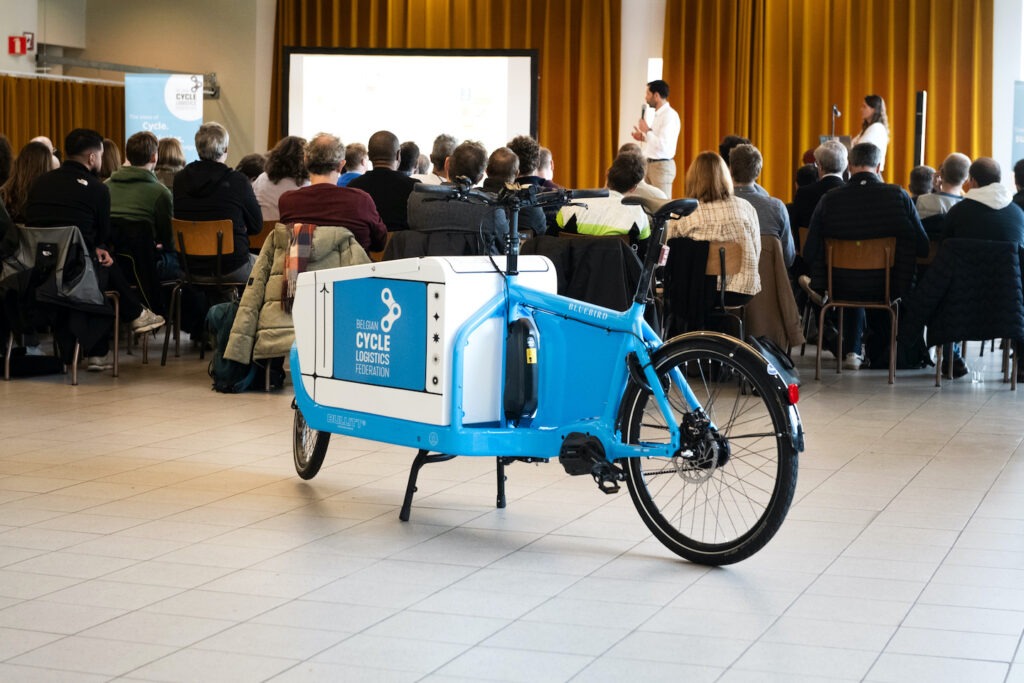
The 2025 edition brings together the ecosystem of bicycle logistics in Belgium: operators, experts, customers, cities, cargo bike producers, researchers and policy makers. The participants have the opportunity to view the material used, which offers a realistic picture of the practice. Thanks to the proximity of logistics hubs of bicycle logistics operators, participants can observe live the operations of bicycle logistics, creating a clear picture of the practice.
Take a look at the full ‘Cycle Logistics Barometer 2024’ on the BCLF’s website here.
Presentation by Philippe van de Casteele at the ICBF 2025: Bike vs. From – Transforming Urban Deliveries in Belgium – how data shows cargo bikes outperforming vans