



January 2, 2026 - California’s new e-bike laws that took effect on January 1, 2026 focus on enhanced safety to reduce fire risks from uncertified lithium-ion batteries, curtailing throttles, requiring better visibility, and potentially holding the parents of minors criminally liable with an inappropriate e-bike.
Under Senate Bill AB 1271, all batteries in e-bikes sold in California must now be tested by accredited laboratories to meet safety certification in compliance with a standard referenced in ANSI/CAN/UL 2849 or EN 15194. Charging systems also need to be certified and the applicable certification standard used to show compliance must be visible and permanently affixed.
The new laws only allow a throttle up to 20mph (32kph) on class 2 e-bikes… “A class 1 or class 3 electric bicycle may have start assistance or a walk mode that propels the electric bicycle on motor power alone, up to a maximum speed of 3.7 miles per hour.”
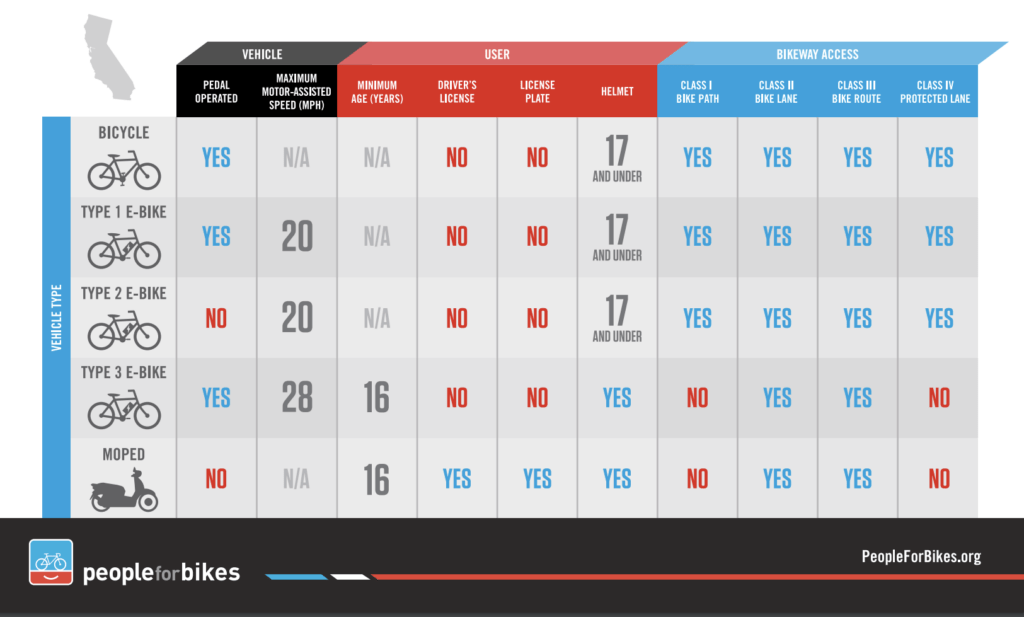
• A ‘class 1 electric bicycle’ or ‘low-speed pedal-assisted electric bicycle’ is a bicycle equipped with a motor that provides assistance only when the rider is pedaling, that is not capable of exclusively propelling the bicycle, except as provided in paragraph (4), that ceases to provide assistance when the bicycle reaches the speed of 20 miles per hour, and that is not capable of providing assistance to reach speeds greater than 20 miles per hour
• A ‘class 2 electric bicycle’ or ‘low-speed throttle-assisted electric bicycle’ is a bicycle equipped with a motor that may be used exclusively to propel the bicycle, and that is not capable of providing assistance when the bicycle reaches the speed of 20 miles per hour
• A ‘class 3 electric bicycle’ or ‘speed pedal-assisted electric bicycle’ is a bicycle equipped with a motor that provides assistance only when the rider is pedaling, that is not capable of exclusively propelling the bicycle, except as provided in paragraph (4), and that ceases to provide assistance when the bicycle reaches the speed of 28 miles per hour, and is equipped with a speedometer
The new law also caps the motor power output at 750 watts regardless of continuous power ratings during acceleration or hill climbing.
Senate Bill AB 1774 prohibits a person from tampering with or modifying an electric bicycle so as to change the speed capability of the bicycle, unless they appropriately replace the label indicating the classification required, and only applies if the bicycle continues to meet the definition of an electric bicycle.
In addition, under bill AB 544 it’s required that e-bikes have a rear red reflector or light that’s on at all times, visible from 500 feet. According to Calbike “… 500 feet is one and a half football fields. How big would a reflector, or even a light, need to be to be visible from that distance? Would a light have to be the size of a car light? While CalBike supports visibility, this measure seems impractical and unnecessary. It also puts the onus for visibility on bike riders, absolving car drivers from responsibility for being aware of other road users and sharing the road responsibly.” – read more here.
Confusion and gray areas pertaining to e-bikes vs e-motos (off-highway electric motorcycles) are now more clearly defined by Senate Bill SB 586 here, meaning that e-motos, which have no pedals, are now considered off-road vehicles.
Finally parents need to aware of the risks that come with children operating e-bikes. Following the increase in incidents involving e-bikes, a PSA was issued by the Riverside County District Attorney’s Office indicating, “Under California Penal Code 273a(a), a parent can be held criminally liable for child endangerment if they provide a minor with an inappropriate e-bike, fail to properly educate them on safe operation, and do not ensure they use required safety equipment—actions that place the child or others at risk of death or great bodily injury. A felony conviction under this statute carries a maximum sentence of six years in state prison.” – read more here.
Senate Bill AB 1271 here.
Senate Bill AB 1774 here.
People for Bikes on California’s eBike Laws here.