


• Flip Book• eNews • eBikes • eAccessories • eCities • eSystems • eAdventures • eBikeTests •

• Flip Book• eNews • eBikes • eAccessories • eCities • eSystems • eAdventures • eBikeTests •
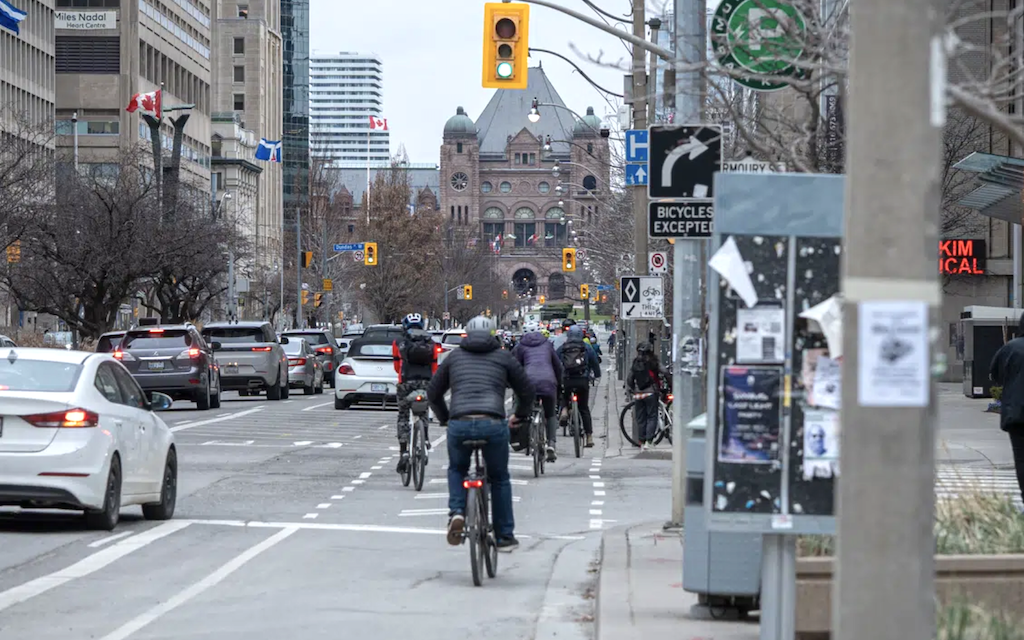
October 18, 2026 - (Toronto, ON) In mid-August, a three-judge panel of the Court of Appeal for Ontario reversed a July 2025 lower-court decision, allowing Premier Doug Ford’s government to remove 19km of protected bike lanes in Toronto along Bloor St., University Ave., and Yonge St.
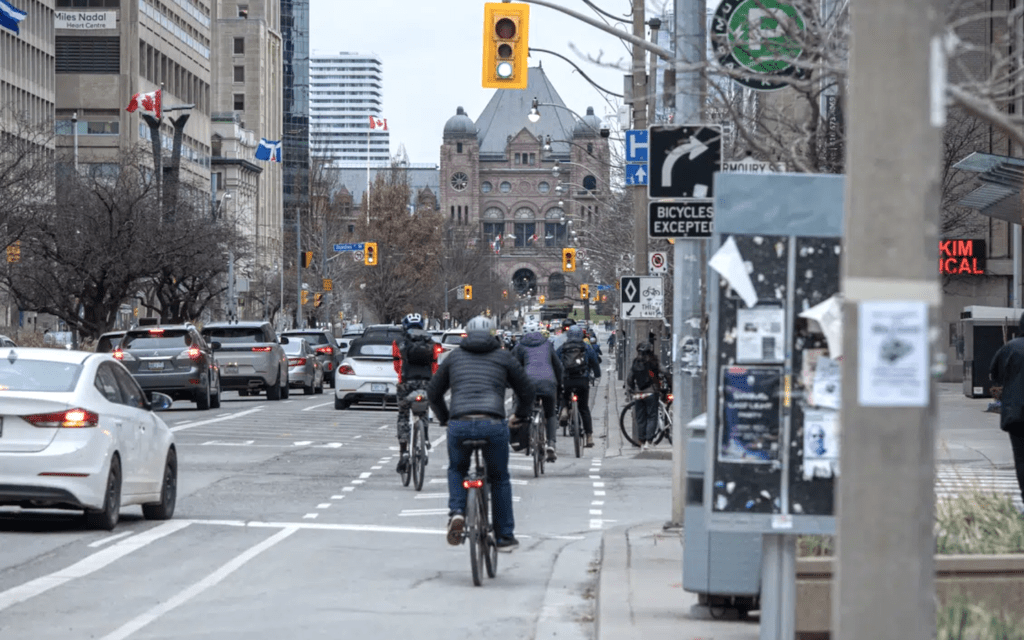
In Nov. 2024, the government sought to remove the bike lanes through Bill 212 (the Reducing Gridlock, Saving You Time Act, 2024). The advocacy group Cycle Toronto challenged the bill, arguing that it would put people at increased risk of harm and death, thereby violating section 7 of the Charter, which protects the right to life and security of the person.
In July 2025, Justice Paul Schabas agreed, writing, “The Applicants have also met their burden of proving that the restoring of a lane of motor vehicle traffic, and its consequent impact on cyclists and road safety, is arbitrary and grossly disproportionate, and therefore not in accordance with the principles of fundamental justice. Cycle Toronto’s application was fully supported by expert evidence.”
The province appealed and, in mid- August 2026, won, when the court ruled, “The legislature is free to legislate to remove a bicycle lane from a road — indeed, it may remove a road entirely — without implicating the Charter.”
According to Justice Grant Huscroft, “The application judge erred in law in interpreting and applying s. 7. But his decision is wrong in a more profound sense, for it subverts a fundamental principle of our democratic constitutional order.” The government “exercised its law-making authority” in passing the bill, which he described as “the sort of decision legislatures make routinely without attracting any concerns about the constitutionality of their actions.”
The province’s own commissioned work: a safety analysis prepared for the Ministry of Transportation by the engineering firm CIMA+ estimated that removing the bike lanes could increase collisions among all road users, including cyclists, pedestrians, and drivers, by as much as 54%, and found no clear evidence that removal would ease congestion.
Yet the appeals judges wrote, “… legislative policy is not arbitrary just because some or even many advisors, experts, and citizens predict that it will not work.”
In Sept. the province issued a request for proposals to bid on removing or reconfiguring more than 19km of protected bike lanes, including those on Bloor, Yonge and University.
Then in early Oct. a Notice of Construction was issued to begin removing a 1.2-kilometre section on Bloor Street W. in Etobicoke between Clissold Road and Royal York Road on October 13.
An All Out protest ride was planned to disrupt, or try to make it difficult for the bike lanes to be removed. In the morning, Cycle Toronto held a press conference announcing that an appeal has been made to the Supreme Court of Canada to weigh in on Ford’s planned bike lane removals.
“The facts are clear: bike lanes do not cause traffic congestion, ripping them out will put people’s lives at risk, and no network of side streets can replace the 19 (kilometres) of protected bike lanes on Bloor, Yonge, and University,” said Michael Longfield, executive director of Cycle Toronto.
Cycle Toronto and its co-applicants are being represented by Ecojustice, an environmental law charity, and Paliare Roland Rosenberg Rothstein LLP.
“We are asking the Supreme Court to hear this case in order to provide clarity about the scope of the rights to life and security of the person protected by Section 7 of the Charter,” said Bronwyn Roe, a staff lawyer with Ecojustice.
They may also seek a stay of the Ontario court’s decision, pending appeal which, “wouldn’t stop the current work but could stop future work on the remaining bike lanes.”
Anyone receiving a judgment from a top provincial or territorial court can appeal to the Supreme Court, that only hears a fraction of cases and typically must involve a key constitutional question.
Hundreds of cyclists showed up for the All Out Protest Ride, that went into the evening, and saw riders blocking the construction pylon trucks, forcing them to leave. Organizers told attendees to be ready to come back the next day.
A City of Toronto staff report from Nov. 2024 estimated the minimum direct cost of removing the 19km of bike lanes at $48 million, on top of the $27 million already spent installing them.
According to Mayor Olivia Chow, the city repeatedly shared designs with the province that would keep both vehicle and bike lanes but the government walked away.
The Ontario Society of Professional Engineers (OSPE) noted the engineering and safety questions regarding the removal of the bike lanes. Engineers have an independent professional responsibility to protect public safety and welfare, and political direction cannot remove that responsibility.
The battle over bike lanes in Toronto continues.