








October 26, 2026 - (Toronto, ON) Olivia Chow has been been re-elected as Mayor of the City of Toronto with a decisive victory and over 54% of the vote (522,558 votes vs 396,994 votes), fending off a late push from her opponent, Brad Bradford, to earn a second term and a full 4-year mandate.
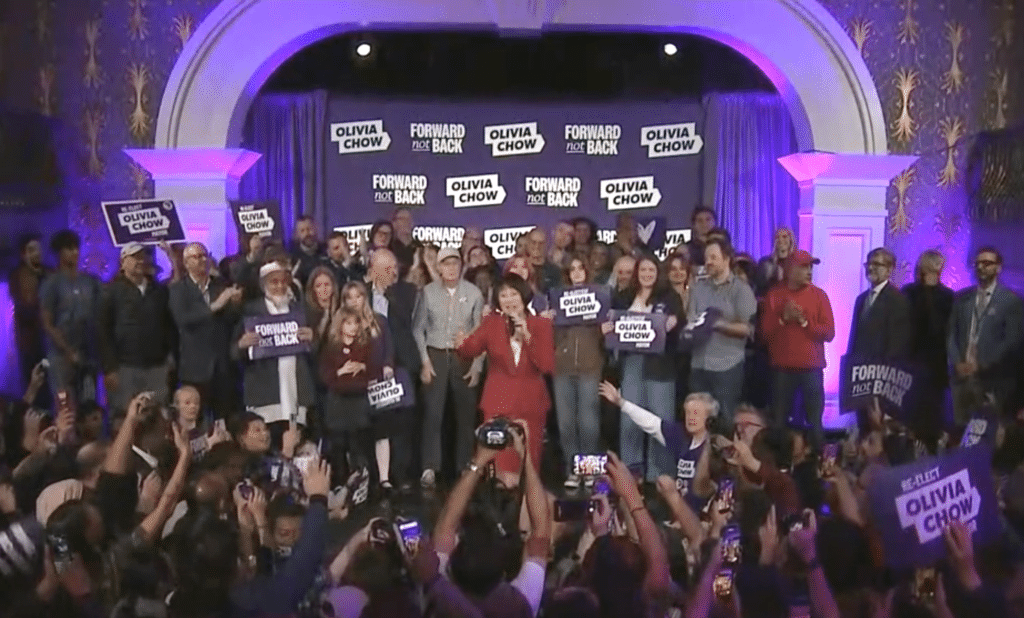
The cycling community is celebrating as Chow is an avid cyclist and a big supporter of cycling and bike lanes, while Bradford has flip-flopped on cycling, first supporting bike lanes and then saying he’d rip out the bike lanes in Etobicoke that Premier Doug Ford recently executed – read more here.
With Chow’s victory the cycling community enjoyed a collective sigh of relief, and hopes that Chow will help stop the removal of more bike lanes by the province next spring.
The re-elected mayor answered “yes” to all categories in Cycle Toronto’s Municipal Election Questionnaire regarding cycling which asked about preserving, rebuilding, upgrading, bike share, and making cycling safe and passable – read more here.
Both Bradford and former federal cabinet minister, Chris Alexander, who dropped out of the mayoral race, did not answer the questionnaire.
Chow had won a byelection in 2023 following John Tory’s resignation and served as mayor for three years. A veteran politician, she had a strong early lead in the polls and when Alexander entered the race she maintained her lead. Before the advance polls opened Alexander dropped out and Bradford gained some momentum with some polls showing him neck and neck with Chow.
Things heated up when Premier Doug Ford, and Minister of Transportation Prabmeet Sarkaria, began ripping out 1.2km of bikes lanes in Etobicoke.
This move followed the Court of Appeal for Ontario overturning a lower court’s ruling that supported Cycle Toronto’s challenge to the province’s Bill 212 which allowed the Ford government to remove bike lanes. Cycle Toronto argued that removing bike lanes would put people at increased risk of harm and death, thereby violating section 7 of the Charter, which protects the right to life and security of the person.
Bradford supported the removal of the bike lanes while Chow was against it calling the removal an “outrageous overreach.”
Documents show that Chow and the city proposed reinstating a lane of traffic on a 1.2-kilometre stretch of Bloor Street West in Etobicoke, between Resurrection Road and Royal York Road, including proposals for the rest of Bloor Street, as well as Yonge Street and University Avenue, that would have kept the bike lanes.
But the Ford government rejected the city’s proposed changes to the cycling corridors and issued a request for proposals (RFP) asking contractors to bid on the removal or reconfiguration of more than 19 kilometres of protected bike lanes along the city’s main arterial streets, including Bloor, Yonge and University.
A report by the engineering firm CIMA+, commissioned by the province, estimated that removing the bike lanes could increase collisions among all road users, including cyclists, pedestrians, and drivers, by as much as 54%, and found no clear evidence that their removal would ease congestion.
A City of Toronto staff report from Nov. 2024 estimated the minimum direct cost of removing the 19km of bike lanes at $48 million, on top of the $27 million already spent installing them. Critics argue that it’s a colossal waste of taxpayers money.
Cycle Toronto is taking the fight to the Supreme Court of Canada “to provide clarity about the scope of the rights to life and security of the person protected by Section 7 of the Charter.”
Chow’s victory adds another strong voice for cycling as the battle for bike lanes continues in Toronto.