












September 16, 2026 - In November 2024, OSPE responded to Bill 212, the Reducing Gridlock, Saving You Time Act, raising concerns that restricting bike lane installation and removing environmental assessment requirements for highway projects would move Ontario away from safe, multi-modal transportation planning. Since then, the legal and legislative picture has changed considerably, and it is worth setting out where things stand now.
What Has Changed Since 2024
- Bill 212 came into force on November 25, 2024, requiring designated municipalities to obtain provincial approval before installing bike lanes that reduce motor vehicle lanes.
- In July 2025, a court found the bike lane removal requirements unconstitutional.
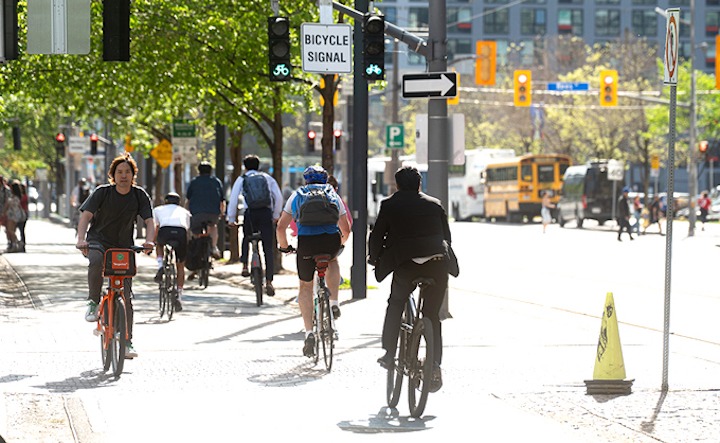
- The province appealed that decision. On August 14, 2026, the Ontario Court of Appeal ruled that the province has the authority to redesign public roadways, clearing the way for the removal of protected bike lanes on Bloor Street, Yonge Street, and University Avenue in Toronto.
- On September 1, 2026, the government issued a request for proposals to begin that removal work.
- Separately, Bill 60, the Fighting Delays, Building Faster Act, 2025, passed in November 2025. It further restricts new bike lane installations that would reduce vehicle lanes and gives the Minister discretion over municipal reimbursement related to the bike lane review framework.
OSPE’s Position, Updated
The Court of Appeal’s ruling settles a constitutional question about legislative authority. It does not settle the engineering and safety questions that prompted our original response to Bill 212.
OSPE continues to believe that changes to transportation infrastructure should be grounded in current, independent engineering evidence and municipal knowledge of local conditions, rather than applied uniformly through provincial directive. Notably, the strongest case for this position now comes from the province’s own commissioned work: a safety analysis prepared for the Ministry of Transportation by engineering firm CIMA+, which surfaced through a court challenge, estimated that removing the bike lanes could increase collisions for all road users, cyclists, pedestrians, and drivers alike, by as much as 54 per cent, and found no clear evidence that removal would ease congestion. A City of Toronto staff report from November 2024 separately put the direct cost of removal at a minimum of $48 million, on top of the $27 million already spent installing the lanes, with the September 2026 request for proposals covering roughly 19 kilometres of lane.
Before construction proceeds, we would encourage the province to publish the full underlying safety analysis, including the portions not yet made public, so that a decision of this scale is made with the same evidence already available inside government.
OSPE also continues to support:
- Multi-modal transportation planning matched to the density and needs of individual communities: mass transit where density supports it, on-demand transit models where it does not.
- Municipal authority to design local transportation infrastructure, informed by provincial coordination rather than provincial override.
- Publicly available cost-benefit and safety analysis for major infrastructure changes, including this one.
On the Broader Gridlock Figures
Provincial officials have also cited a $56 billion annual cost of gridlock in Ontario when defending the government’s approach to traffic congestion generally. That figure comes from a report by the Canadian Centre for Economic Analysis, commissioned by the Residential and Civil Construction Alliance of Ontario (RCCAO) and the Ontario Road Builders’ Association. The figure is also a province-wide estimate, not specific to these three streets, so on both counts it should not be presented as evidence about the effect of this particular bike lane removal.
Looking Ahead
OSPE will continue to monitor developments under both Bill 212 and Bill 60, and to advocate for transportation decisions in Ontario that are evidence-based, safety-focused, and responsive to the needs of individual municipalities.
Read more here – h/t Michael Longfield/Cycle Toronto